


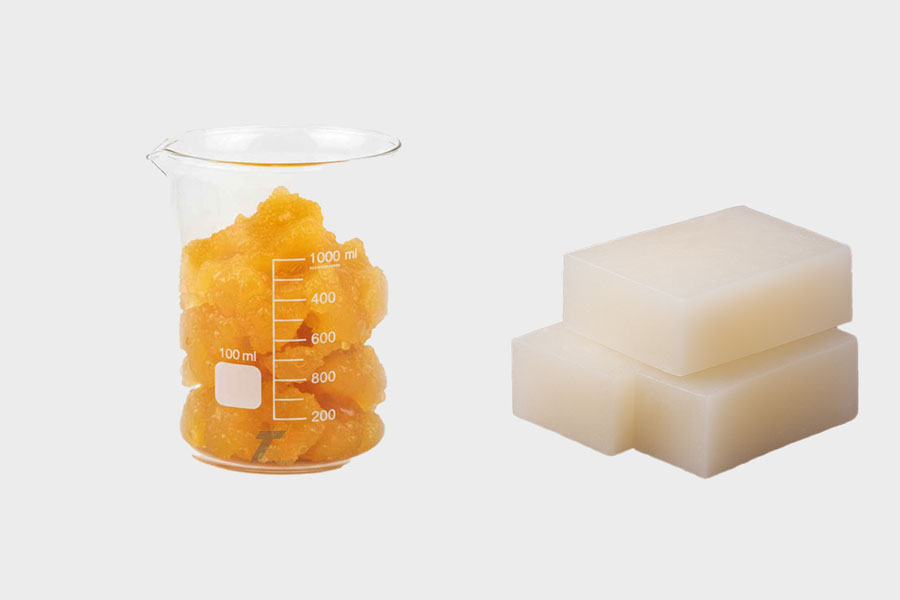
If you are active in the candle-making, plastics, packaging, or industrial lubricant manufacturing industries, you have likely encountered two widely used materials: Foots Oil and Paraffin. But the main question is: What is the difference between Foots Oil and Paraffin, and which one is the smarter choice for your business? This article provides a comprehensive and precise examination of these two petroleum-based materials; from their composition and characteristics to their applications, price, and safety standards. Join us so you can make an informed and cost-effective decision based on the real needs of your business.
What is Foots Oil?
Definition
Foots Oil (or Residue Wax) is actually a by-product of the paraffin wax production process.
In other words, when paraffin wax is produced, there is a residual part which is called Foots Oil; this product contains a mixture of paraffinic hydrocarbons, some liquid oil, and wax.
Technical Characteristics
It usually has a semi-solid or viscous state and its melting point may be around 40 to 60 degrees Celsius.
It has a relatively high oil content, for example, 30-50% in some grades.
Its aromatic and sulfur content is relatively low, meaning it has good chemical stability.
From a safety and environmental perspective, it is considered a low-risk product (in industrial grade) but it is not suitable for sensitive uses like food or pharmaceuticals.
Applications of Foots Oil
Use as a raw material or additive in the rubber and plastics industry (as a plasticizer, mold release agent);
Use in wood coating products, chipboard, leather, textiles;
Use in the production of waxes, industrial lubricants, or improving the properties of the final product;
It can be considered as a more economical option for businesses looking for raw materials with lower cost.
Points for Purchasing Foots Oil
Check the grades: oil content, melting point, viscosity grade, color.
Ensure the supplier provides technical specifications (CoA, analysis).
Packaging and transportation are important: the product may be semi-solid and require storage temperature (e.g., below 50°C);
Pay attention to the final application: if your application is sensitive to health/food standards, Foots Oil may not be suitable.
What is Paraffin?
Definition
Paraffin refers to a group of saturated hydrocarbons (CnH2n+2) which can be in liquid form (liquid paraffin) or solid form (paraffin wax).
In fact, “Paraffin” is a general term and can refer to various products such as kerosene, paraffin wax, paraffin oil, etc.
Types and Applications
Paraffin Wax: A solid, colorless or white substance, usually with a melting point of about 46 to 68 degrees Celsius.
Paraffin Oil or Liquid Paraffin: A liquid hydrocarbon, has diverse industrial and pharmaceutical uses.
Applications: Candle-making industries, coatings, insulation, lubricants, pharmaceutical and food industries (in specific grades);
Technical Characteristics
Paraffin wax is very stable, not highly reactive, has a specific melting point, and can be an insulator or coating.
Liquid paraffin can be a mixture of saturated hydrocarbons with specific characteristics like different boiling points and viscosity.
Regarding safety, depending on the grade, especially for health or food uses, it must be checked. For example, petrochemical companies have warned that poorly refined paraffins may contain aromatic compounds which are dangerous.
Points for Bulk Paraffin Purchase
Specify which type you mean: paraffin wax or liquid paraffin.
In bulk purchases, check the grade and purity (e.g., oil content, melting point, color, aromatic content).
Packaging and transportation: wax must be in conditions where it does not melt, liquid must be protected from evaporation.
Consider the final application (e.g., food industry, candles, lubricants, coatings) to select the appropriate grade.
Difference Between Foots Oil and Paraffin
In this section, we will examine the “Difference Between Foots Oil and Paraffin” in detail and highlight key points for businesses.
Origin and Production Process
Foots Oil is a by-product of the paraffin wax production process; meaning first paraffin wax is produced, and what remains or results from the wax separation process is Foots Oil. Paraffin can be the main product obtained from crude oil, oil shale, or coal extraction, which is then purified.
Composition and Physical Characteristics
Foots Oil: Semi-solid or viscous, higher oil content (e.g., 30-50%), lower melting point, a combined state of wax and oil.
Paraffin: Depending on the type, it can be completely solid (wax) or completely liquid. Paraffin wax usually has high purity, a specific melting point, less reactivity, and is white or colorless.
Different Applications
Foots Oil is mostly used for industrial applications that are not sensitive to food or pharmaceutical hygiene (e.g., rubber, plastics, leather, coatings).
Paraffin has a wider range and can extend to more sensitive uses like candle-making, food industries, pharmaceutical or cosmetic coatings (in the appropriate grade).
For example: Paraffin wax for candle-making, insulation, packaging; whereas Foots Oil is used for producing lubricants, rubber industry;
Cost and Economic Advantage
In terms of cost, Foots Oil is usually a more economical option because it is a by-product and its production cost for the manufacturer may be lower.
Paraffin, especially in high and purified grades, costs more.
Therefore, if your business requires very high quality or sensitive uses, Paraffin may be more suitable; but if you are looking for lower cost in industrial applications, Foots Oil can be a smart choice.
Technical Points and Standards
Foots Oil may not be suitable for health, cosmetic, or food uses, as its grade is usually industrial.
Paraffin: Depending on the grade, it can comply with pharmaceutical or food standards (e.g., white wax, refined liquid paraffin).
One of the important points is the presence of aromatic compounds in petroleum materials; for example, in reviews of mineral materials used in food, it has been emphasized that aromatic compounds (MOAH) can be dangerous.
Foots Oil
Advantages:
More economical compared to higher grades.
Suitable for industrial applications that do not require very high purity.
Good stability, low aromatics, applicable in production conditions.
Applications:
Rubber and plastics industry (plasticizer, mold release agent)
Wood coatings, chipboard, flooring, leather, textiles
Use as a raw material in formulations where the final product quality is important but sensitivity to very high hygiene is not.
Note: If your business is in the field of industrial coatings, rubber, plastics, or surfaces, Foots Oil can be a suitable option.
Paraffin
Advantages:
Wide range of applications: from candle, packaging, insulation industries to pharmaceutical/food uses (in appropriate grade).
Ability to adjust melting point, viscosity, color and other characteristics (especially paraffin wax).
In more sensitive industries, the possibility of use with high purity exists.
Applications:
Candle production, food packaging, waterproof coatings, insulation, lubricants, cosmetic and pharmaceutical materials (in high grade)
Paraffin wax for insulation, thermal storage, electrical insulators. Wikipedia
Note: If your business is in a field where high quality, health standards, or product appearance is important (for example, candle making, food or cosmetic packaging), paraffin will be the smarter choice.
Economic Review: Which is More Suitable for Your Business?
In this section, we address several key questions that will help you decide which product is more suitable for your business.
First Question: What is your final application?
If your final product has an industrial application (for example, part manufacturing, industrial coating, rubber, plastics) where sensitivity to final appearance or high hygiene is not important, “Foots Oil” has more economic value.
If your product is for the end consumer, or appearance, quality, and health standards are important to you, “Paraffin” is the better option.
Second Question: What standards are required for your product?
If you require health or food standards, review the higher grades of paraffin. If these matters are not important to you, you can use Foots Oil.
Third Question: How much are your production and sales costs?
If you have a limited budget or want a lower initial capital cost, Foots Oil is part of the solution. If you have the budget and quality is your priority, choose paraffin.
Fourth Question: How important are the supplier and supply continuity to you?
Ensuring continuous supply, consistent quality, and technical specifications is important. For example, Foots Oil may be a by-product and have more quality fluctuations; therefore, choosing a reliable supplier is important.
Final Recommendation
For businesses such as decorative production, luxury packaging, candle making, cosmetic products: Paraffin is the more suitable choice.
For businesses such as industrial part manufacturing, wood or textile coatings, rubber or plastics production where the final quality is purely industrial: Foots Oil can be an economical and logical choice.
Technical Issues, Standards, and Purchasing Points
Technical Points for Foots Oil
Check analysis: Oil Content (%), melting point, viscosity, color.
Packaging, storage: Because it may be semi-solid, storage conditions are important.
Ensure that the product is industrial and is not permitted for human consumption or food use, unless it has a specific grade.
Technical Points for Paraffin
Specify the type of paraffin (wax or liquid).
Purity, existing standards (for example, for food/pharmaceutical uses).
Melting point, viscosity, color and aromatic compounds: are important.
Ensure compatibility with your production process (melting, casting, molding, coating) and maintenance requirements.
Standards and Safety
Some paraffins may contain aromatic or naphthalene compounds that are problematic in food/pharmaceutical uses.
Foots Oil: According to a summary from Shell, it is a low-hazard substance but has transport and storage requirements (temperature must not exceed 50 degrees Celsius). Shell
Adhering to safety requirements, packaging, storage, and transportation is essential for achieving quality and avoiding legal or technical problems.
Conclusion
Considering what has been said, the difference between Foots Oil and Paraffin in terms of origin, composition, application, and cost is completely clear. If we want to summarize:
Paraffin: Suitable for applications where quality, appearance, health or food standards are important; a choice with higher cost but higher added value.
Foots Oil: A more economical option, suitable for industry and less sensitive applications; if your business is in an industrial sector where appearance or hygiene is not critically important, it is the more suitable choice.
For your store, I suggest that by accurately analyzing the target market, desired quality, and bulk purchase quantity, you choose the appropriate product and include explanations such as “Purchase Foots Oil”, “Bulk Paraffin”, “Sale of Paraffin” in the product description section and blog of your website. This will also help your site’s SEO, because the article is written with the keyword “Difference between Foots Oil and Paraffin” and secondary keywords have also been included in the text.
Frequently Asked Questions about “Difference Between Foots Oil and Paraffin”
Question: What is Foots Oil?
Answer: Foots Oil or Residue Wax is a by-product of paraffin wax production that is produced from the wax separation process and has a combination of paraffinic hydrocarbons and oil.
Question: What type of product is Bulk Paraffin?
Answer: Paraffin can be solid wax or liquid oil. When we say “Bulk Paraffin”, we usually mean paraffin wax or paraffin oil in industrial grade and purchased in bulk for production or subsequent processing.
Question: For a manufacturing business that produces wood or chipboard coatings, which do you recommend between Foots Oil and Paraffin?
Answer: In this type of application, where sensitivity to appearance or hygiene is not very high, Foots Oil will be a more economical and suitable option; unless the final coating is presented as a final consumer product with high standards.
Question: Can paraffin be used for food or pharmaceutical industries?
Answer: Yes, provided the intended paraffin grade complies with health/pharmaceutical standards; but this requires a reliable supplier, purity guarantee, standard labeling, and a higher price.
Question: What points should I observe when purchasing Foots Oil or Bulk Paraffin?
Answer: Checking technical specifications (oil content, melting point, viscosity, color), determining the appropriate grade for your application, ensuring a reliable supplier, suitable packaging and transport conditions, and compliance with standard requirements (if the application is sensitive) are among the most important points.
